From 17 to 19 June 2026, TeamUP partners met in Vienna for three days of testing, hands-on feedback and exchange between technology providers, researchers and practitioners.
The event was hosted by the Johanniter Research and Innovation Centre and the Austrian Institute of Technology. The Vienna Laboratory Tests LT2.4–2.5 form part of the project’s second round of laboratory testing and focused on the latest components of the TeamUP toolkit. This toolkit is being developed to support first responders during complex chemical, biological, radiological, nuclear and explosive (CBRN-E) incidents.
Over the course of the three days, participants assessed the technologies from both a technical perspective and through the lens of end users who may rely on them in demanding emergency situations. Practitioners and observers provided structured feedback on usability, functionality and operational applicability.
The programme began with the Work Site Operation App Mixed Reality Training, which allows responders to train in realistic virtual scenarios, covering both trainee and trainer perspectives. Subsequent sessions focused on the Digital Triage Toolkit for casualty prioritisation and monitoring, health monitoring tools for first responders, and AR Glasses that can provide relevant information directly in the responder’s field of view. On the second day, partners tested technologies related to decontamination, victim detection, and situational awareness. These included the Fast Deployable Mass Decontamination system, a portable inflatable decontamination tent for rapid deployment, the Body Pose Estimation Tool, which supports decontamination procedures through visual analysis of body posture. UAV-based victim detection was tested to support the localisation of affected people from the air, while environmental sensing solutions focused on monitoring the incident area. DECON equipment tracking and the Citizen Awareness App added further support for operational coordination and public safety information. The final day was dedicated to re-testing, group discussions, and a joint debriefing.
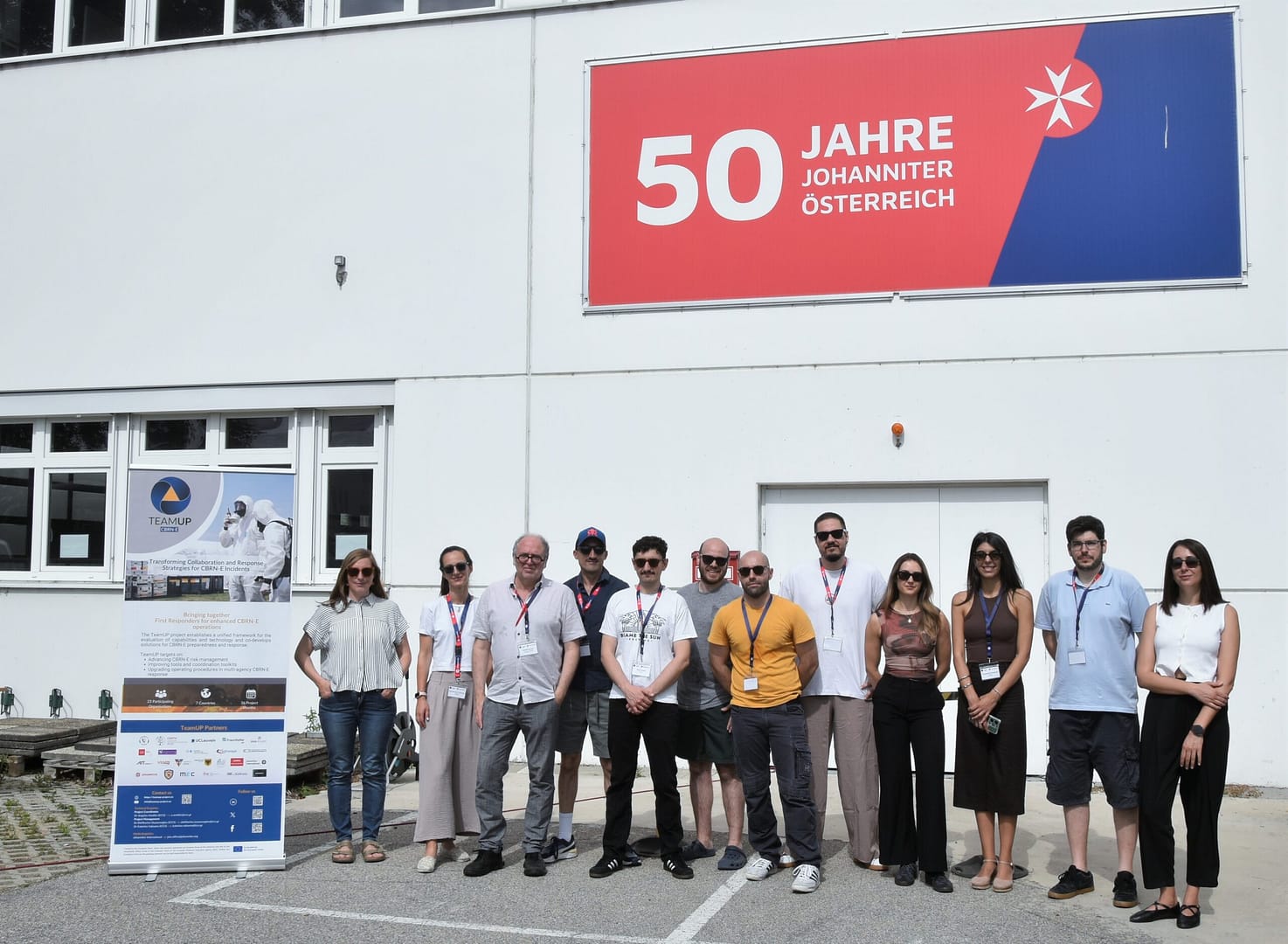
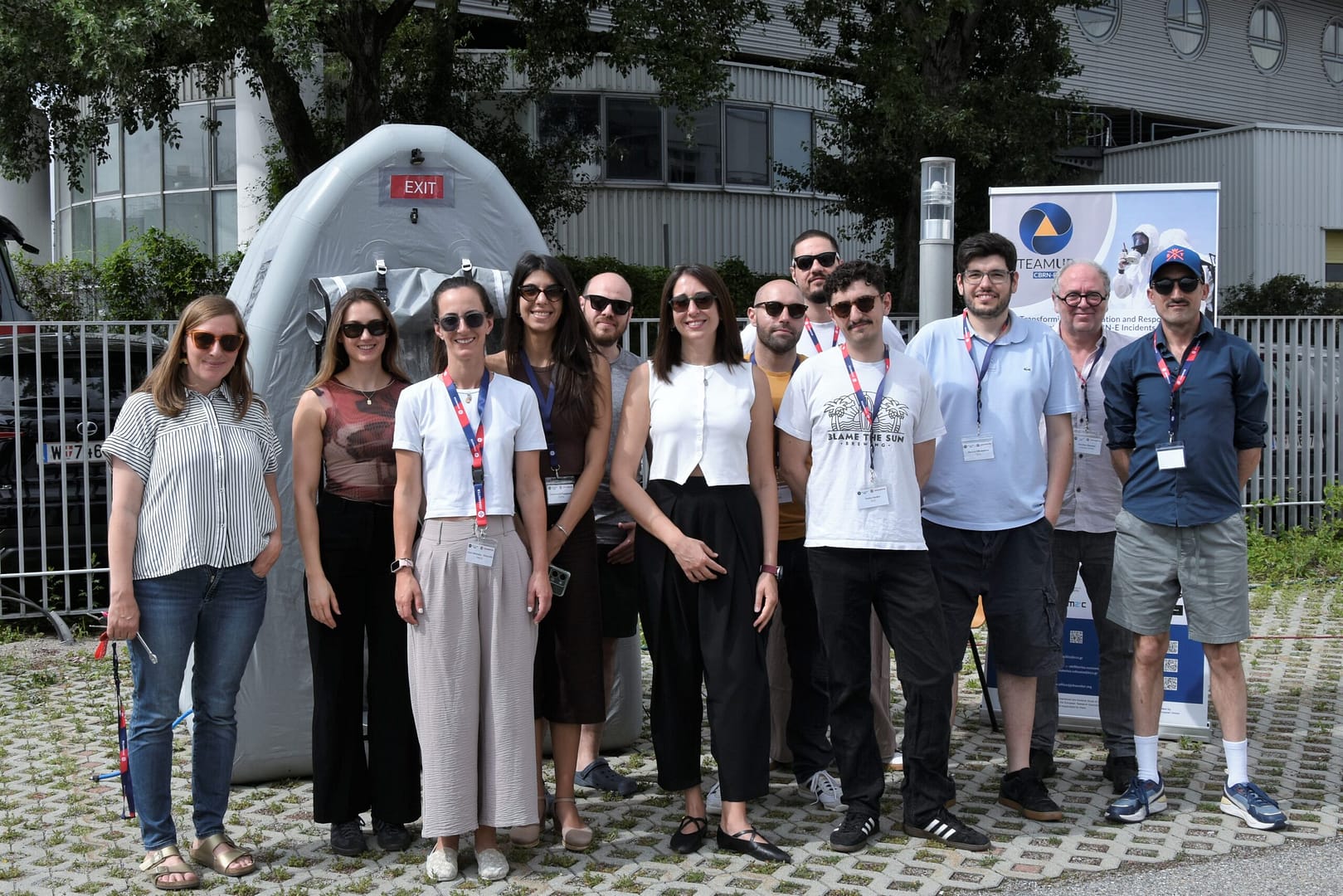
The Vienna tests underscored the importance of integrating different types of support for CBRN-E response, including hazard detection, localisation, triage, decontamination, training, situational awareness and decision support. By combining these capabilities, TeamUP aims to help emergency teams operate more safely, coordinate more effectively and respond faster in high-risk situations.
A particular focus was placed on the needs of both specialised CBRN-E responders and teams without specific CBRN-E expertise. This reflects a central principle of TeamUP: technologies should not only be technically robust, but also intuitive, usable, and relevant for a wide range of first responders.
The Laboratory Tests were organised by the Johanniter Research and Innovation Centre and Campus VESTA, with support from the Austrian Institute of Technology, EXUS AI Labs, the Institute of Communication and Computer Systems, the Centre for Research and Technology Hellas and the wider TeamUP consortium. Practitioner input was provided by experienced emergency response and civil protection representatives, including the Lyon Fire and Rescue Service and the Hellenic Ministry of National Defence.
The insights gathered in Vienna will directly inform the next stages of the project and guide further refinement of the TeamUP toolkit ahead of larger validation activities.
Building on this progress, the consortium will continue its testing campaign with upcoming laboratory tests in Brussels, Euskirchen and Rheinbach in July 2026. These tests will focus on additional tools for chemical, biological, radiological and explosive detection, as well as decision support. Technologies to be evaluated include FemtoMachine and Dover for chemical detection and calibration, Backpack LAMP and FET-LAMP for rapid biological detection, the Beta Gamma Probe for radiological detection, RapID for explosives identification and the Decision Support Toolkit for operational guidance during CBRN-E incidents.
The results from the Vienna trials and the subsequent laboratory tests will form a consolidated evidence base for the next phase of the project, paving the way towards the Full-Scale Trials in Lyon in August 2026 and in Athens in October 2026, where the integrated TeamUp toolkit will be assessed in realistic operational environments.